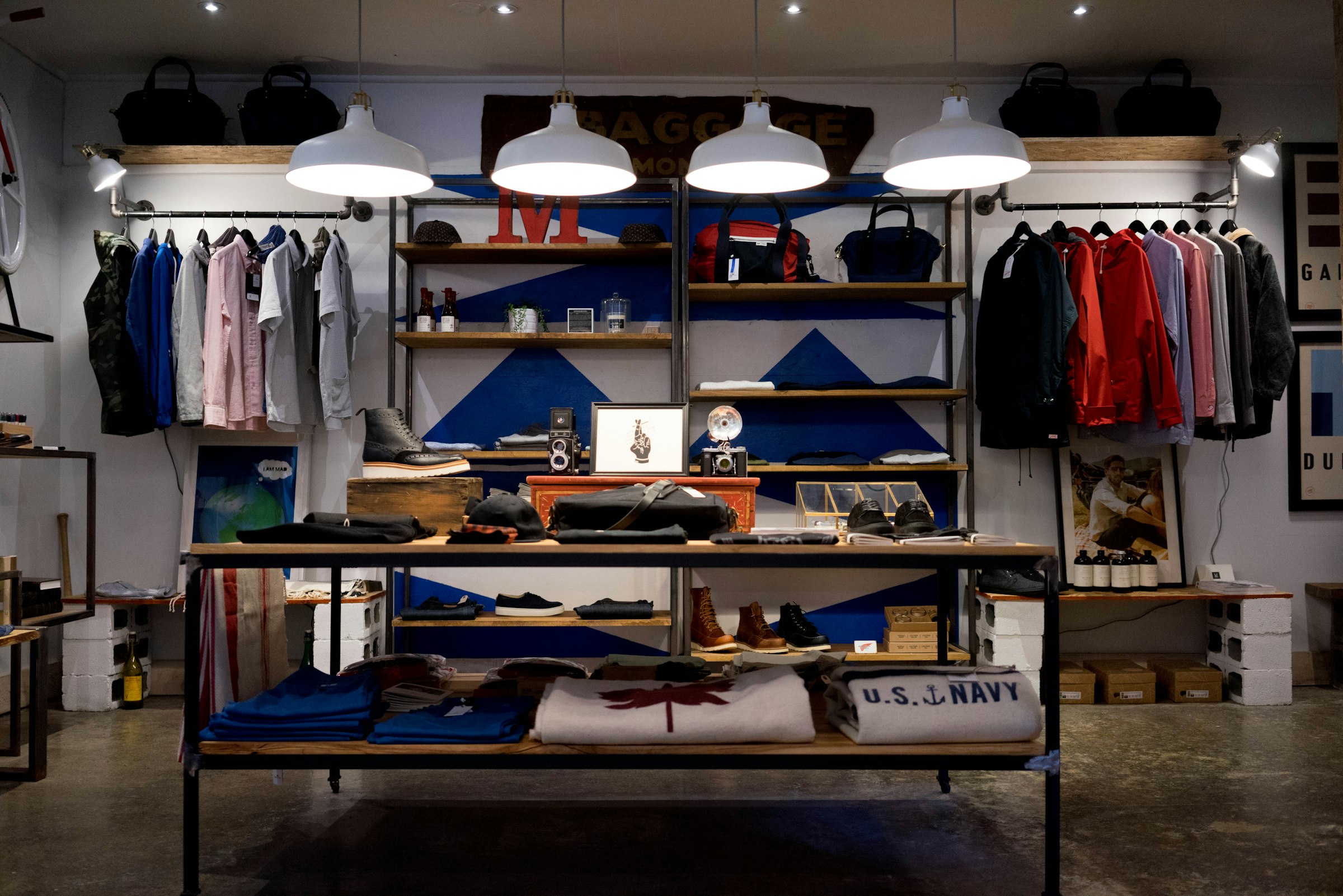
Komehyo Holdings, the Nagoya-listed reuse company, finished its financial year at the end of March with 334 stores across the group. Two hundred and ninety-four of them are in Japan. Of those 294, exactly thirteen are shops.
The rest are counters. Two hundred and twenty-one are purchasing centres — rooms where you bring things and a trained appraiser gives you money for them. Another sixty do both. Add it up and Japan's largest luxury resale business runs 281 places where it will buy something from you and 73 where you can buy something from it, and in the year just ended it opened twenty-three more purchasing centres and eight combined stores.
It had a record year. Consolidated sales of ¥221.7 billion, up 39.4%. Operating profit up 50.4%. The amount paid out to individuals for their own possessions — the company reports this as a headline metric, which tells you where it thinks the business is — hit ¥104.1 billion, up 32%. Auction volume, where the surplus goes when retail can't absorb it, was ¥106.9 billion, up 53.7%. In the fourth quarter alone, operating profit more than tripled.
Hold that against the other story the resale industry told this year, which was that it had run out of things to sell.
Komehyo's own investor deck states the problem in a way the American version of this industry has not. Citing a Mercari and NLI Research Institute survey published last November, it puts the value of goods lying dormant in Japanese households — bought, unused for over a year, still in the house — at around ¥91 trillion. The visible reuse market, it says, represents 3.6% of that.
Then the strategic conclusion, in the company's own flat language: expanding touchpoints will convert non-users into experienced reusers, and that is the key to market growth.
That is a theory of the bottleneck, and it is a different theory from the one Silicon Valley holds. The American answer to "there is a fortune sitting in people's bedrooms" is an app, a photo flow, and a seller who does the photography, the sizing, the condition grading and the pricing herself. Komehyo's answer is a room, an appraiser, and cash the same afternoon. One of those approaches has a capex line. The other has a churn problem.
Quick disclosure before we go on: I'm building a wardrobe cataloguing app, so this argument runs directly past my own front door. Read the rest knowing that.
I don't think the counter model beats the app model on economics, and Komehyo's own numbers show the strain — gross margin runs in the low twenties, the retail ratio fell 3.7 points as more volume got pushed through wholesale auction, and net profit grew far slower than sales. But it is the only version of this business I can find anywhere that has stopped treating supply as something that arrives and started treating it as something you go and get, at scale, with buildings. The company is now aiming at ¥310 billion by the year ending March 2029, with 30% of sales from overseas — currently 12.1%, spread across Taiwan, Thailand, Singapore and Hong Kong, with the Greater Bay Area and North America named next.
Now the other end of the axis.
Musinsa, the Korean platform, has been building the reverse trade: Korean clothes into Japan. Its Global Store did 182% year-over-year growth in Japanese transactions in the second quarter of this year, after 116% in the first — two consecutive quarters of triple digits, on a three-year average annual growth rate of 136%. By August, Japanese transaction volume for the year had already passed the whole of 2025. Japan sales in 2025 were more than five times what they were in 2023. Customers are spread across all 47 prefectures, which is the detail that separates a real market from a Tokyo novelty.
The company established Musinsa Japan in 2021 and spent five years on logistics and pop-ups before touching physical retail. In April it ran a seventeen-day Musinsa Standard pop-up in Tokyo; transactions there rose 170% on the previous month, the brand's strongest month of global sales. Japanese customers shopping Musinsa's Korean stores were up 86% year over year in the first quarter. The first permanent Tokyo store opens next year.
This is not one platform's fluke. Ably, a competing Korean platform, reported partner brands Lyny and Jasmine Bell up 290% and 275% respectively in Japan between January and July. Korean clothing and accessory exports in the first half went $104.21 million to Hong Kong and $46.15 million to Taiwan — second and third destinations globally, behind the United States.
So: Seoul selling into Tokyo, Taipei and Hong Kong. Nagoya buying from Japanese households and selling into Taipei, Bangkok, Singapore and Hong Kong. Two large, compounding, opposite-direction trades, and the Western intermediary in both of them is nobody.
Here is the comparison I want to make carefully, because it is easy to make dishonestly.
These companies are not large next to European luxury. LVMH did €38.6 billion in the first half alone. Komehyo's entire year was roughly a fortieth of that. Musinsa's Japanese business is growing at 182% because it started from very little. Nothing here says the balance of power has moved.
What it says is that the balance of attention is badly calibrated. LVMH's half-year release gave no regional revenue figures at all — the geographic commentary was four sentences, of which Asia got one: growth outside Japan, confirming improvement since late 2025. That is what the Asian market is, in the primary document of the industry's largest company. One clause.
And that clause is doing the work of at least four markets that are not behaving alike. Tokyo's growth this year came substantially from resale and from inbound tax-free spending — Komehyo's tax-free sales ratio was up 50.2% year over year in the fourth quarter. Seoul's came from exporting mid-priced own-brand clothing to that same Japanese consumer. Hong Kong and Taipei are absorbing both. None of these is the story of whether the Chinese luxury shopper is back, which is the only Asian story most of the Western trade press ran this month.
The habit to break is the one where a thing becomes real when it reaches here. A Korean label selling out in Osaka has already happened. It is not a preview of anything. It is the event.
- Komehyo group: 334 stores; 294 domestic (13 sales stores, 221 purchasing centres, 60 purchase-and-sales stores); 40 overseas across 6 countries/regions — Komehyo Holdings FY March 2026 results briefing, 15 May 2026, p.2
- FY to March 2026: consolidated sales ¥221,707M (YoY 139.4%), operating profit ¥9,288M (YoY 150.4%), individual purchase amount ¥104,079M (YoY 132.0%), auction GMV ¥106,918M (YoY 153.7%), profit attributable to owners ¥5,488M (YoY 114.9%) — all record highs — Komehyo briefing, p.2
- Q4 FY2026: operating profit YoY 326.6% ("more than tripled"); net sales YoY 136.1%; individual purchases YoY 137.6%; tax-free sale ratio YoY 150.2%; gross margin 21.3%; operating margin 5.5% — Komehyo briefing, p.3
- Opened 23 purchasing centres and 8 purchase-and-sales stores in FY2026 — Komehyo briefing, brand & fashion segment page
- Retail ratio 44.8% (−3.7pt YoY); overseas ratio 12.1% (−0.5pt); domestic tax-exemption ratio 14.6% (−0.8pt) — Komehyo briefing, p.2
- ~¥91 trillion of dormant household assets in Japan; visible reuse market = 3.6% of that; "expanding touchpoints will convert non-users into experienced reusers" — Komehyo briefing, market section, citing "A Survey on Japan's 'Owned Assets'," Mercari Inc. + NLI Research Institute, released 20 Nov 2025 [VERIFIED — note this is Komehyo's slide citing Mercari's survey, not the survey itself. ¥91tn covers all dormant household goods, not apparel. The body says "goods," not "clothes." Keep it that way]
- Medium-term plan: ¥310bn sales by FY ending March 2029, overseas sales ratio target 30%; overseas footprint in Taiwan, Thailand, Singapore, Hong Kong; ASEAN, Greater Bay Area and North America named for expansion — Komehyo briefing, medium-term plan and FY2027 outlook pages
- Musinsa FY2025 revenue KRW 1.4679tn (+18.1%), operating profit KRW 140.5bn (+36.7%); Q1 2026 revenue KRW 363.6bn (+24.1%) — Seoul Economic Daily, 28 May 2026 [VERIFIED (SINGLE SOURCE, secondary)]
- Japan Global Store transactions +182% YoY in Q2 2026 after +116% in Q1; Ably partner brands Lyny +290% and Jasmine Bell +275% Jan–Jul 2026; Korean clothing/accessory exports H1 2026 $104.21M to Hong Kong and $46.15M to Taiwan, 2nd and 3rd after the US — Seoul Economic Daily, 11 Aug 2026 [VERIFIED (SINGLE SOURCE, secondary) — the export figures are reported, not traced to Korea Customs. Worth a second pin if this runs]
- Japan transactions passed full-year 2025 total within ~7 months; Japan sales in 2025 more than 5× 2023; three-year average annual growth 136%; customers across all 47 prefectures; first Tokyo store in 2027; Musinsa Japan established 2021 — Seoul Economic Daily, 27 Aug 2026 [VERIFIED (SINGLE SOURCE, secondary)]
- Tokyo pop-up: 17 days, Musinsa Standard + Beauty, transactions +170% month-on-month in April, strongest month of global sales; Japanese customers at Korean stores +86% YoY in Q1 — Lee Kyung-min, The Korea Times, 6 May 2026
- LVMH H1 2026 revenue €38.6bn; organic growth +2% H1 and +3% Q2; regional commentary is qualitative only — "Asia (excluding Japan) saw strong growth, confirming the improvement in trends observed starting in the second half of 2025" — LVMH H1 2026 release, 27 Jul 2026 (also on lvmh.com) [VERIFIED — but one secondary summary gave H1 organic as +3%, not +2%. Reconcile against the release before publishing that figure. Also: a separate summary claimed "Asia ex-Japan up 6% in H1." That number is not in the release and is not used here]
- "China's luxury market has stalled" — Widely asserted; LVMH's own release says Asia ex-Japan saw strong growth [UNVERIFIED — CUT. The piece originally hung on a China-slowdown contrast. The primary source contradicted it. Do not reinstate without Bain/Altagamma or company-level numbers]
- The "Shanghai Four" (Shushu/Tong, Oude Waag, Samuel Gui Yang, Mark Gong) as the third distinct market in the argument — WWD headline confirms the grouping; article paywalled, and it covers the spring 2026 season [CUT — STALE. Six months old. Shanghai Fashion Week's next season runs in October; this is a piece to write then, not a paragraph to bolt on now]
- Japan's fashion reuse market at ~¥1.1 trillion; total reuse market ¥3.5tn heading to ¥8tn by 2030 — Statista and aggregator write-ups; original Yano Research / Reuse Business Journal figures not reached [UNVERIFIED — CUT. Komehyo's own numbers carry the section without it]