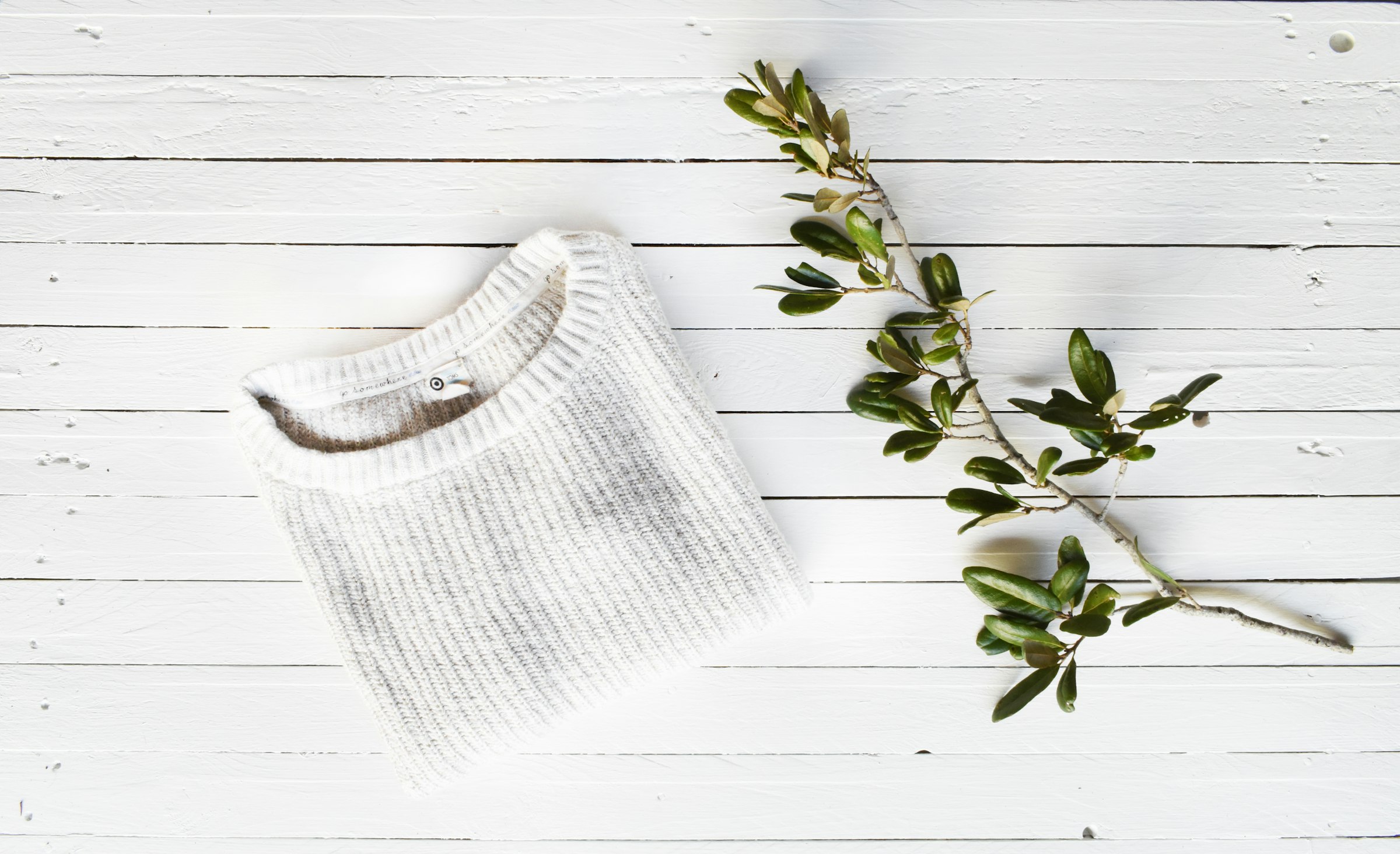
A knit on a hanger is lying to you. Not maliciously — structurally. A sweater is thousands of loops holding hands, and loops stretch. Hang one and gravity goes to work: the shoulders grow two small peaks where the hanger ends press up, the body lengthens, the hem narrows, and what you photograph is not your sweater but your sweater mid-distortion. This is why a knit shot on a hanger always reads a size wrong and slightly tired. The garment's true shape is the shape it takes at rest.
So: rest it.
Find the window first. Daylight, indirect — a spot near a window out of the direct beam. Lamplight turns cream sweaters yellow and navy ones black, and the whole point of this photo is that months from now it tells you the truth about a color you've half-forgotten. No flash, ever; flash flattens texture, and texture is most of what a knit is.
Then the three moves. One: lay it face-up on a plain, flat surface — a bed with a smooth cover works, a wood floor works — and smooth it from the collar downward with open palms, like you're calming it. You're chasing air, not wrinkles. Two: set the sleeves. Fold each one back at the shoulder seam so it runs alongside the body, cuff visible near the hem — the torso keeps its honest width and the sleeve still shows its length and its cuff, which is where a knit ages first. Three: square the hem. A gentle tug at each corner so the bottom edge sits straight. Crooked hems photograph as stretched hems, and then you stop trusting the picture.
Shoot from directly above, phone flat — parallel to the sweater, not angled, because an angle turns a medium into a crop-top or a tunic depending on which end you're standing at. Get the whole garment in frame with a little margin. That's it. No styling, no artful sleeve-flop. The artful photos are for other people; this one is for you.
It takes about ninety seconds, and it's worth doing properly for one reason: this photo is the closet's memory. When it tells the truth — real color, real shape, real texture — you reach for the sweater again, because the picture reminds you of the actual thing. When it lies, you scroll past your own clothes. The sweater deserves better, and so, on a cold morning three months from now, do you.